
How to choose a HEPA filter
Grade, sealing method, frame material and depth are four separate decisions. Getting the grade right and the seal wrong is a common and expensive way to fail a validation.
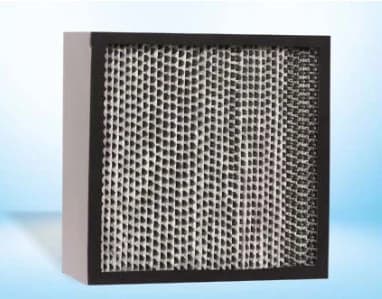
A HEPA filter enquiry usually arrives as a size and a quantity. That is enough to send a price, and not enough to send the right filter. There are four independent decisions behind a HEPA specification, and they fail in different ways.
First, what HEPA actually commits to
HEPA stands for High Efficiency Particulate Air. To qualify, a filter must remove 99.97% of particles greater than or equal to 0.3 micron. That is a definition rather than a claim, and it sets the floor. Filters meeting it correspond to grades H13 and H14 of EN1822 and support ISO Class 5 operation as per ISO 14644.
The 0.3 micron figure is not the smallest particle a HEPA filter catches, which is a common misreading. It is close to the most penetrating particle size, the size at which the filter performs worst. Particles both larger and smaller than that are captured more efficiently. Specifying against 0.3 micron is therefore a conservative test, not an upper limit on capability.
When to go beyond standard HEPA
Super HEPA filters remove up to 99.99% of particles at 0.3 micron, including ultra fine particulate. That step is worth taking where the process is already at the limit of what filtration supports, which in practice means research laboratories, some pharmaceutical manufacturing, and nanotechnology work. For the majority of pharmaceutical and healthcare rooms, a correctly installed H13 or H14 is the right answer and a higher grade buys pressure drop rather than performance.
Second, the sealing method, which is where money gets lost
This is the decision most often left to whoever installs the filter, and it is the one most likely to cause a validation failure. The filter's certificate tests the media. It says nothing about whether air will leak around the frame once the filter is in a housing.
| Gasket seal | Gel seal | |
|---|---|---|
| How it seals | Compression gasket, typically neoprene or silicone | Knife edge on the housing seats into a gel channel on the filter |
| Tolerance to an imperfect housing | Lower, needs a flat and true sealing face | Higher, gel accommodates minor irregularity |
| Usual application | AHU filter banks, ducted positions, general HVAC | Terminal ceiling positions, Class 5 and above |
The rule of thumb: the closer the filter is to the product, the more the seal matters relative to the media. In a terminal ceiling position above a critical process, gel seal is normally the correct specification. In an AHU filter bank several metres upstream, a gasket seal is entirely appropriate and cheaper.
Third, frame material
Frame choice is driven by what the filter will be exposed to, including the cleaning regime, rather than by the air itself.
- Extruded aluminium profile: the general default, light and dimensionally stable.
- GI (galvanised iron): economical for less demanding positions.
- SS 304: where the filter is washed down, or where the surrounding equipment is stainless and the filter should match it.
- SS 316: where chlorides or aggressive chemicals are present and 304 would eventually pit.
Sealant and gasket materials follow from the same question. Epoxy or polyurethane resin is standard for HEPA construction, with neoprene or silicone gaskets. Where temperature is a factor, high temperature filters rated up to 250 C can be manufactured on request, and that is a construction decision made at the point of order rather than a variant that can be swapped in later.
Fourth, depth, which is usually a building constraint
Deep pleat HEPA filters with glass paper ribbon separators are typically 150 mm or 300 mm deep. Mini pleat construction packs the media into closely spaced pleats and fits the same grade into a 75 mm frame. When ceiling void depth is fixed, that is often the deciding factor, and it is better established before the ceiling is designed than after.
What a supplier needs in order to quote properly
Most incomplete enquiries are missing the same handful of items. Supplying them at the outset usually removes a round of back and forth.
- Face dimensions and depth, or the housing type the filter has to fit.
- Required efficiency or EN1822 grade, and the ISO class the room has to hold.
- Sealing method, gasket or gel, and the housing it seats into.
- Frame material, and whether the filter will be washed down.
- Airflow volume per filter, which determines pressure drop and therefore fan sizing.
- Operating temperature, if it is not ambient.
- Whether a DOP test port is required for installed integrity testing.
Published by MAP FILTERS (INDIA) PVT. LTD..