
ISO 14644-1 cleanroom classes, explained without the jargon
What an ISO Class 5 room actually commits you to, why the class is a measured result rather than a design choice, and how the number relates to the filters you install.
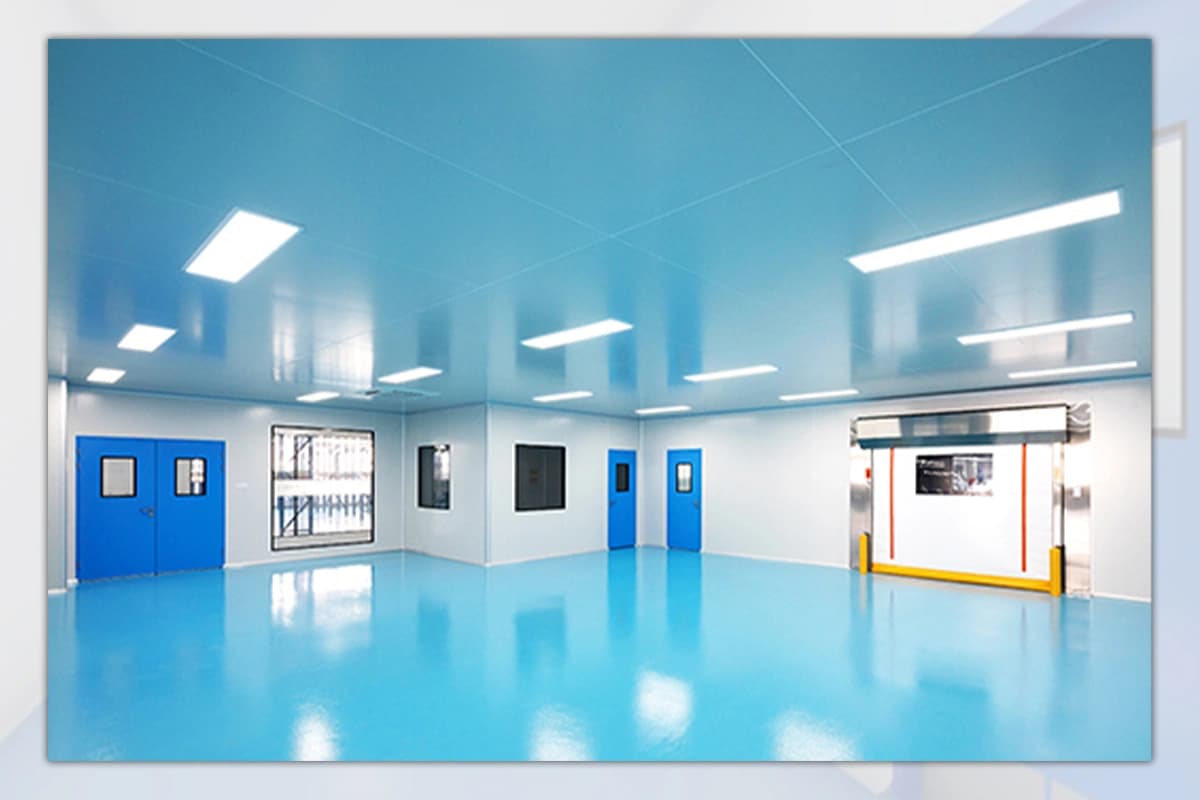
Almost every cleanroom conversation starts with a number. A client needs a Class 7 room, or has been told the process requires Class 5. The number is doing a lot of work in those sentences, and it is worth being precise about what it does and does not mean.
The class is a particle count, nothing more
ISO 14644-1 classifies a controlled environment by one thing: the maximum permitted concentration of airborne particles at or above a given size, per cubic metre of air. The class number is the exponent. An ISO Class 5 environment permits 100,000 particles of 0.1 micron and above per cubic metre; an ISO Class 8 environment permits 100,000 particles at 0.5 micron and above. Every other property people associate with cleanrooms, including temperature, humidity, pressure cascade and microbial limits, is specified separately and is not part of the class.
This matters in practice because a room can be fully compliant with its ISO class and still be unsuitable for the process running in it. Classification says nothing about viable organisms, and nothing about whether the air is chemically clean. A laboratory handling solvents can hold Class 5 particle counts with solvent vapour throughout, because a particle counter does not see molecules in the gas phase.
Where each class is normally used
| Class | Typically used for |
|---|---|
| ISO Class 5 | Aseptic filling, laminar flow work stations, terminal sterile positions, semiconductor process areas |
| ISO Class 6 | Areas immediately supporting Class 5 zones, some device assembly |
| ISO Class 7 | Background rooms around aseptic zones, general sterile manufacturing support, operation theatres |
| ISO Class 8 | Material and personnel entry areas, gowning rooms, general controlled production |
The laminar flow equipment we manufacture, including horizontal and vertical laminar air flow units, garment cubicles, air showers and dynamic pass boxes, is built to ISO Class 5 at a velocity of 0.45 +/- 0.05 m/s. That is worth noting because it is a common source of confusion: a piece of Class 5 equipment does not make the room around it Class 5. It creates a Class 5 zone within a room of a lower class, which is usually the economical way to get Class 5 conditions exactly where the process needs them.
Classification is measured, not specified
This is the part that most often surprises people commissioning their first room. You do not get a class by installing the right equipment. You get it by demonstrating the particle count under test. The room is classified on the basis of measurement, which means the class can be lost without anything visibly changing.
ISO 14644-1 also distinguishes the state the room is tested in. As-built means empty. At-rest means equipment installed and running, no personnel. Operational means the process running with people in the room. The same room will report three different particle counts, and the operational figure is always the worst of the three, because people are the largest particle source in most cleanrooms. A class quoted without the occupancy state attached is incomplete information.
How filtration and air changes produce a class
Two mechanisms hold a class. The first is filtration efficiency: what fraction of particles the terminal filters remove from the supply air. The second is dilution: how many times per hour the room's air volume is replaced, which determines how quickly particles generated inside the room are carried out of it.
Filtration alone will not do it, because most contamination in an occupied room originates inside the room rather than arriving through the ducts. This is why the same filter grade appears in rooms of very different classes; the difference between them is usually air change rate and airflow pattern, not filter selection.
- Terminal HEPA filters, at H13 or H14 to EN1822, establish the cleanliness of the incoming air.
- Air change rate dilutes and removes internally generated particulate.
- Airflow pattern determines whether that dilution actually reaches the critical zone or short-circuits back to the return.
- Pressure cascade stops less clean air migrating in from adjacent areas when a door opens.
The failure mode nobody designs for
A correctly graded filter can be installed and the room can still fail its classification, because the air is going around the filter rather than through it. Bypass leakage at the filter-to-housing joint is invisible on a drawing and does not show up in the filter's factory test certificate, since that certificate tests the media, not the installation.
This is why installed filter integrity testing exists, and why terminal filter sealing method is a genuine engineering decision rather than a preference. A gel seal filter uses a channel of gel into which a knife edge on the housing seats, which removes the bypass path that a compression gasket can leave if the housing is not perfectly flat. At Class 5 and above, that detail frequently matters more than the filter grade itself.
Published by MAP FILTERS (INDIA) PVT. LTD..