
Why a cleanroom needs four filter stages, not one
Skipping the cheap stages is the most common false economy in air filtration. Here is what each stage in the train is actually doing, and what it costs to leave one out.
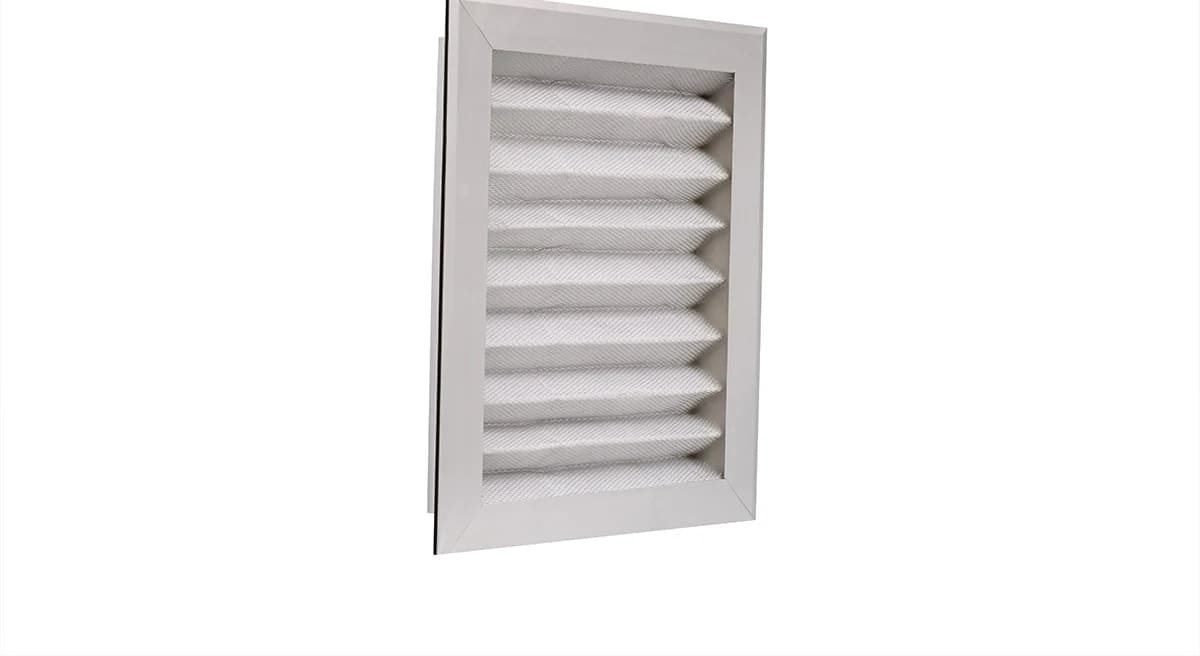
Filtration is a sequence, and each stage exists to protect the one behind it. That sounds like an engineering nicety until you price a year of HEPA replacements in a system that had no pre filters, at which point it becomes an accounting matter.
Stage one: the pre filter
The first stage captures the coarse load, dust, pollen, dander and lint, before it reaches anything else. Synthetic media pre filters run at around 95% efficiency at 5 micron and are washable, which is the entire economic argument: the cheapest element in the train is also the only one you can clean and put back.
Leave this stage out and the coarse particulate is removed by whatever comes next. Fine filters and HEPA filters will do that job perfectly well. They will simply do it once, because they are not washable, and then need replacing. A pre filter costs a fraction of a HEPA and is doing the same work at that end of the particle range.
Stage two: the fine filter
Fine filters cover the intermediate range: bacteria, mould spores, fine dust and allergens that pass a pre filter. They correspond to grades F5 to F9 of EN779 and MERV 8 to 15 of ASHRAE 52, and typically run around 97% at 3 micron with an initial pressure drop of roughly 3 mm WC.
In a cleanroom this is a protective stage for the terminal HEPA. In commercial and healthcare buildings it is frequently the last stage in the system, which makes it the filter that determines the air quality occupants actually experience.
Stage three: the HEPA filter
The terminal HEPA is what establishes the room's cleanliness class, removing 99.97% of particles at or above 0.3 micron. It is also the most expensive element in the train and the one with the highest pressure drop, typically 25 mm WC initial rising to 50 to 70 mm WC at end of life.
That pressure drop is the other reason staging matters, and it is the one people forget. A loaded filter is a restrictive filter. Every stage that fills up prematurely raises the resistance the fan has to work against, which means more energy for the same air change rate, and eventually means the design airflow is not achieved at all. A neglected filtration train degrades the room's performance long before anything is visibly wrong.
Stage four: gas phase, when it is needed
The first three stages all intercept particles. None of them does anything measurable to a gas, because a molecule of solvent vapour is orders of magnitude smaller than the particles the media is designed to capture, and it passes straight through.
Removing gases requires adsorption rather than filtration, which is what an activated carbon bed provides for odours and volatile organic compounds. This stage is not needed in every installation. Where it is needed, no amount of upgrading the particulate filters will substitute for it. Where depth is limited, combination filters integrate particulate and gas phase media into a single position.
Extending service life without changing grade
Once the stages are right, the remaining variable is media area. Pocket and bag filters form the media into pockets, giving far more surface area than a flat panel of the same face dimensions. The grade is unchanged; the service interval is longer, because there is more media to load before the pressure drop limit is reached.
For facilities where a filter change is disruptive, that is often worth more than a marginal efficiency improvement would be.
A practical maintenance rule
- Change on pressure drop, not only on the calendar. The pressure differential across a filter is the direct measure of how loaded it is; elapsed time is only a proxy for it.
- Wash and reuse pre filters rather than discarding them.
- Record the commissioning pressure drop for every stage. Without that baseline, a later reading cannot be interpreted.
- Test terminal HEPA filters in place through their DOP ports, so the seal is tested as installed and not only the media as manufactured.
Published by MAP FILTERS (INDIA) PVT. LTD..